Wine story
Why Every Plan Falls Apart over Wine—and Succeeds Precisely Because of It
There are two kinds of people in the business world: those who believe success begins in Excel spreadsheets, and those who know success lies in the glass.
3 min read
Anyone who has ever tried to write a five-year plan sober knows it only goes well until the first line is down. “Revenue growth of 20% p.a.”—and already it sounds like the menu at a vegan fast-food restaurant: ambitious, but somehow suspiciously empty. By the first glass of wine, you realise that perhaps, before growing revenue, you need a chair you can sit on comfortably during meetings.
Making Plans, Raising Glasses
Every founder’s biography tells you that the best ideas emerged at two in the morning in a loft. What they never mention: there was an empty bottle of Merlot beside the whiteboard, and the groundbreaking vision of “Food Delivery 2.0” was really just a desperate attempt to make pizza compatible with red wine.
The next glass is always the enemy of structure. Yet paradoxically, it is precisely this glass that kicks you out of the hamster wheel of PowerPoint slides. While sober minds work through their roadmaps along linear timelines, the wine drinker invents an air taxi for pets along the way. Useless? Perhaps. But hey: “disruption” once sounded like a boozy excuse, too.
Historically Grounded Evidence (or What Passes for It)
Caesar crossed the Rubicon, historians claim, after a feast with robust Falernian wine. Had he stuck to water, he would probably have stayed in the tavern. Goethe supposedly wrote “Faust” inspired by Rhine wine—the second half of the work certainly reads like a literary hangover. And Churchill? The man led an entire country through the war—accompanied by cigars, whisky and a respectable wine list. Steve Jobs is said to have scribbled his first iPhone design on a napkin. I bet the other side of that napkin bore the words: “Another glass of Chardonnay.”
The Glass as True Disruption
The start-up scene loves to talk about “disruption”. Yet most of it amounts to little more than a new delivery model for salad. The true disruptor has been on our tables for thousands of years: wine.
Plan A: Write a marketing strategy.
Glass 1: Minor spelling mistakes, but still professional.
Glass 2: Walls of Post-it notes full of “moonshot ideas”.
Glass 3: Pitch for an app that opens wine bottles by itself.
Glass 4: Investor convinced.
The chain is simple: no glass, no chaos, no success.
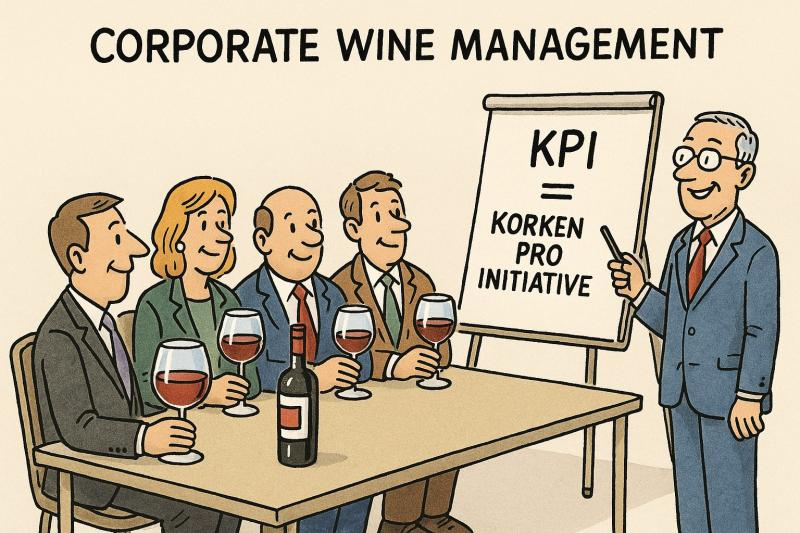
Corporate Wine Management
Anyone who wants to get ahead in big companies today has to love buzzwords. So here is my proposal: “Next-Glass Thinking”. Meetings no longer begin with an agenda and a flip chart, but with a first glass of Riesling. KPIs then become “Korks per Initiative”. Targets are measured in “litres per quarter”. And anyone who drinks water for too long is dismissed by the board for being “undercorked”.
The Start-up and the Chardonnay
Remember the legendary Berlin start-up that developed a device to open wine bottles via Bluetooth. Nobody needed it. Nobody wanted it. Yet the founders received five million euros in seed funding—and later explained that the idea had emerged during an evening of Chardonnay, after they had spent three hours trying to remove a cork with a screwdriver. A success story? Yes. Product discontinued? Also yes. But anyone laughing has not had any Chardonnay.
Productivity in a Haze of Lists
They say wine lowers productivity. Nonsense! Wine changes productivity. Anyone writing a to-do list sober ends up with:
Reply to emails
Do the shopping
Prepare a presentation
After the next glass, the list looks like this:
Save the universe
Invent a bicycle helmet for squirrels
Pitch my own Netflix series
And this is precisely where the magic lies: nobody wants to see the hundredth presentation. But a founder who seriously claims to be building the first streaming service for pets gets attention—and perhaps capital.
The Wine Exit
In the end, every company dreams of an exit. IPO, sale, unicorn status. But let’s be honest: the true exit is the last sip from the bottle, when you realise: “Tomorrow we really will get started.” Success is not an Excel spreadsheet. Success is the glass that carries you across the boundary from reason to vision.
Conclusion
The next glass is a curse and a blessing. It puts an end to plans, destroys Excel spreadsheets, ruins pitch decks. And that is precisely where its value lies. Because without the next glass, there would be no wild ideas, no absurd innovations, no founding stories that read like fairy tales.
So: drink responsibly—but do drink. Because in the end, business is just like life: no glass, no plan. No plan, no success.
Die Weinpost