Cheese · Aged hard cheese
When Cheese Crunches and Wine Softens
Aged hard cheese pairs well with a full-bodied, fresh Chardonnay, fruity Spätburgunder and dry Oloroso Sherry. Salt can soften tannins, while plenty of umami can make wine seem harsher, so a powerful red is not automatically the best choice.
- Salty
- Umami
- Rich & creamy
3 min read · Rebe & Traube editorial team
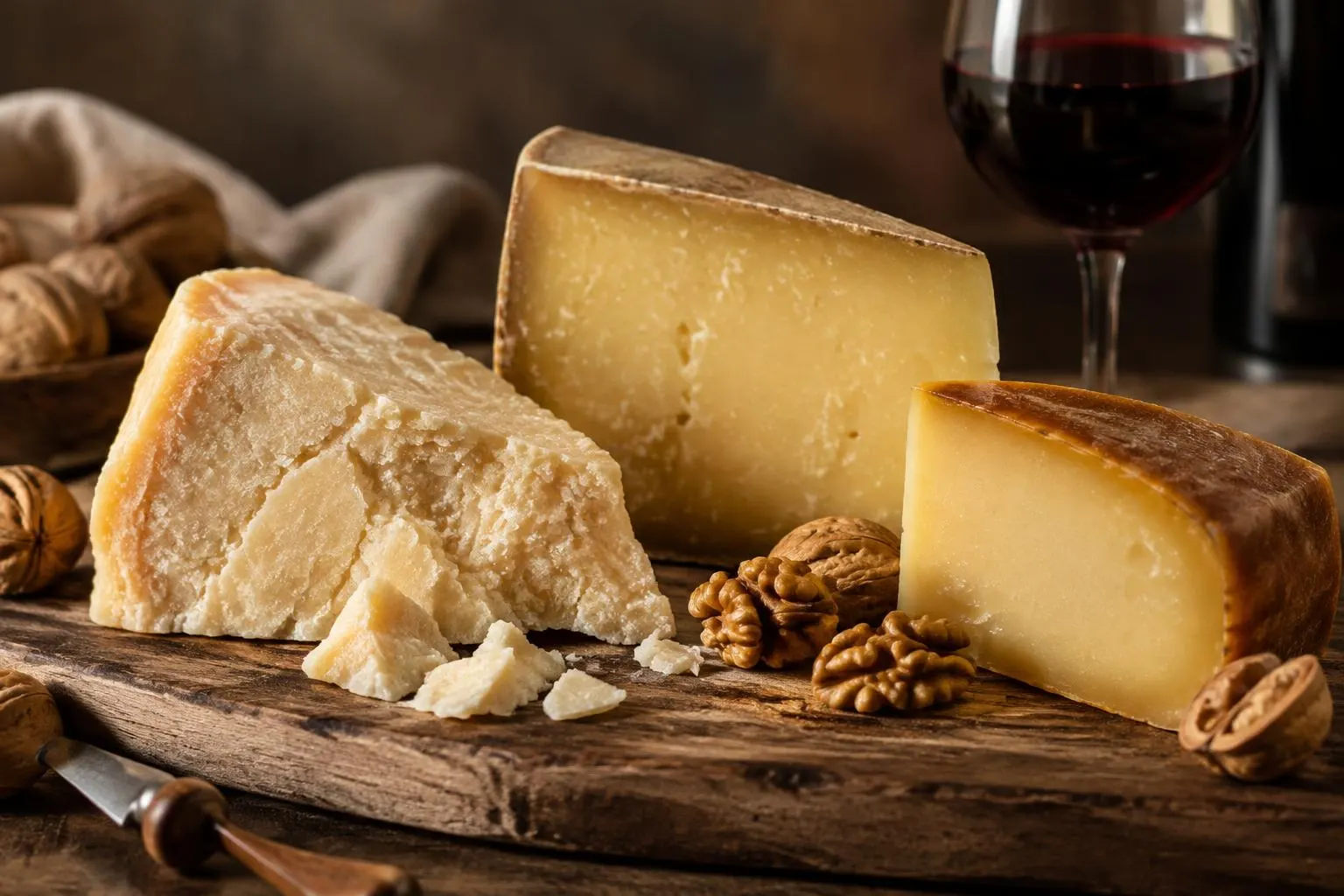
A piece of aged Gouda breaks off unevenly, Comté smells nutty, and tiny crystals in Parmigiano crunch between your teeth. There is plenty happening on a board like this, even without fig mustard and grapes. The right wine needs intensity, but it need not be deep red. A full-bodied Chardonnay with freshness, a juicy Spätburgunder or a dry Oloroso can offer very different, equally compelling pairings. After all, cheese has more than just a bold side.
Salt and umami pull in different directions
Aged hard cheese concentrates salt, fat and umami in varying proportions. Salt often makes wine seem fuller and smoother, softening perceived bitterness and tannin. That explains why a red that seemed angular on its own can suddenly feel more approachable alongside salty cheese. But it is only part of the story. Not every aged cheese is equally salty, and not every red responds to the same degree.
Umami, by contrast, can make wine seem more bitter, acidic and astringent, as well as less sweet and fruity. This matters particularly with long-aged Parmesan. Salt can counteract the effect, and a little acidity in the food also helps restore balance. Umami with Miso, Mushrooms and Parmesan explores the details. For the cheese board, the practical recommendation is to favour balanced fruit and restrained tannins over sheer power.
Three glasses, three directions
A medium- to full-bodied Chardonnay with lively acidity pairs well with Comté and many mountain cheeses. Its texture stands up to the fat, while its acidity refreshes the mouth after each bite. Subtle oak influence can echo nutty notes. Lots of sweet-seeming toasted aromas, however, are not automatically helpful, especially when the cheese is delicate and relatively mild. Freshness remains more important than the most lavish winemaking treatment possible.
Fruity Spätburgunder is a good choice for anyone who likes red wine with cheese. Alongside a salty mountain cheese, its moderate tannins can feel pleasantly smooth. Very mature, umami-rich Parmesan calls for a little more caution, as the fruit can recede. Choose a juicy style without heavy extraction. A slightly cool glass often feels livelier than a red that has spent a long time in a warm kitchen.
Dry Oloroso Sherry is the characterful third option. Its nutty, oxidative aromas can make a convincing match for aged Gouda or mature Comté. Oloroso is high in alcohol, though, and calls for small servings and a cheese with enough intensity. Make a point of choosing a dry style. The world of Sherry also includes sweetened versions, and a brown colour alone tells you nothing reliable about sweetness.
The accompaniments are not just extras
Fig jam, honey and sweet fruit bread fundamentally change a cheese board. Sweetness in food makes wine seem drier, more acidic and more bitter. If a sweet topping dominates the bite, the wine should taste at least as sweet. In that case, a suitably sweet wine can make more sense than any of the three dry recommendations. For a dry pairing, the simplest solution is often to try a piece of cheese with plain bread first.
Walnuts add bitterness, while tart fruits bring a different balance. With three very different cheeses on a board, not every sip has to work equally well with every piece. That is no failure on the host's part. For softer cheeses and blue cheeses, the overview of cheese and wine offers further directions. The lingering creaminess of long ageing can also be considered through the kokumi principle, without treating it as an additional basic taste.
Interactive wine selector
How do you prepare Aged hard cheese?
The default is a typical preparation. Adjust the settings to how your dish actually tastes, and the suggestions update instantly.
Wine styles to suit your dish
Choice 1
Champagne or grower-produced Sekt brut
Why it works: it is low in tannins and handles umami well and acidity and freshness cut through the fat.
Choice 2
Sauvignon Blanc
Why it works: acidity and freshness cut through the fat and it is low in tannins and handles umami well.
Choice 3
Grüner Veltliner
Why it works: it is low in tannins and handles umami well and acidity and freshness cut through the fat.
Get to know the Grüner Veltliner grape variety
Best avoided – Sweet red wine, such as Ruby Port. As a rule here, it is much sweeter than the dish and tastes cloying alongside it. Individual wines may vary.
The suggestions are wine styles, not specific bottles. Taste is personal, so feel free to try something that breaks the rules.
The smallest cheese board in the world
Set out a small piece each of Comté and Parmigiano. Taste the same fruity red wine on its own first, then after each cheese. Pay attention to tannin, fruit and body rather than immediately choosing a winner. Repeat the comparison with Chardonnay. Even this tiny selection shows why the blanket rule of red wine with cheese falls short.
For an alcohol-free option, a gentle apple spritzer is an uncomplicated choice with salty hard cheese. A lightly brewed, cooled roasted grain tea can also work with nutty cheeses, provided it is not bitter. Neither replaces wine, but neither needs to. Their job is to leave you looking forward to the next bite after a savoury mouthful.
Brief and honest
- Full-bodied Chardonnay with fresh acidity – Pairs with the fat and nutty notes of Comté and mountain cheese. More about Chardonnay
- Fruity Spätburgunder – Moderate tannins leave room for the cheese. Salt can make them seem smoother. More about Spätburgunder
- Dry Oloroso Sherry – Nutty, oxidative aromas complement aged Gouda and Comté. Its higher alcohol calls for small servings.
Wine advisor: find the right grape variety in three questions · All grape varieties at a glance
Probably not – Very tannic red wine with little fruit. Plenty of umami can intensify bitterness and astringency. Salt in the cheese softens this effect, but does not always offset it.
Alcohol-free – A gentle apple spritzer pairs well with salty hard cheese. Lightly brewed roasted grain tea is a less fruity alternative, as long as it does not taste bitter.
How helpful was this article?
No sign-up and no cookies. We only store the stars, the article and a non-traceable identifier that changes daily to prevent repeat ratings. Ratings appear only after editorial review.
Try this at home
Try fruity Spätburgunder on its own first, then with Comté and Parmigiano. Compare the fruit and tannin. Repeat the experiment with a fresh Chardonnay.
What this article is based on
- WSET Level 2 Award in Wines, Spezifikation mit dem Kapitel zu Wein und Speisen
- Wine & Spirit Education Trust (WSET), How to pair wine with your favourite takeaway meals
- Ohsu et al. (2010), Involvement of the calcium-sensing receptor in human taste perception, Journal of Biological Chemistry
The scenes in this article are illustrative stories, not reporting. The basic rules follow WSET teaching; personal taste may differ.