Taste basics · Long-simmered broth with aged cheese
When a Spoonful Lingers
Long-simmered broth and aged cheese pair well with a structured Chardonnay, a dry Chenin Blanc or a low-tannin Spätburgunder. The choice of wine depends not on kokumi alone, but also on salt, umami, fat and the intensity of the broth and cheese.
- Umami
- Kokumi
- Salty
- Rich & creamy
3 min read · Rebe & Traube editorial team
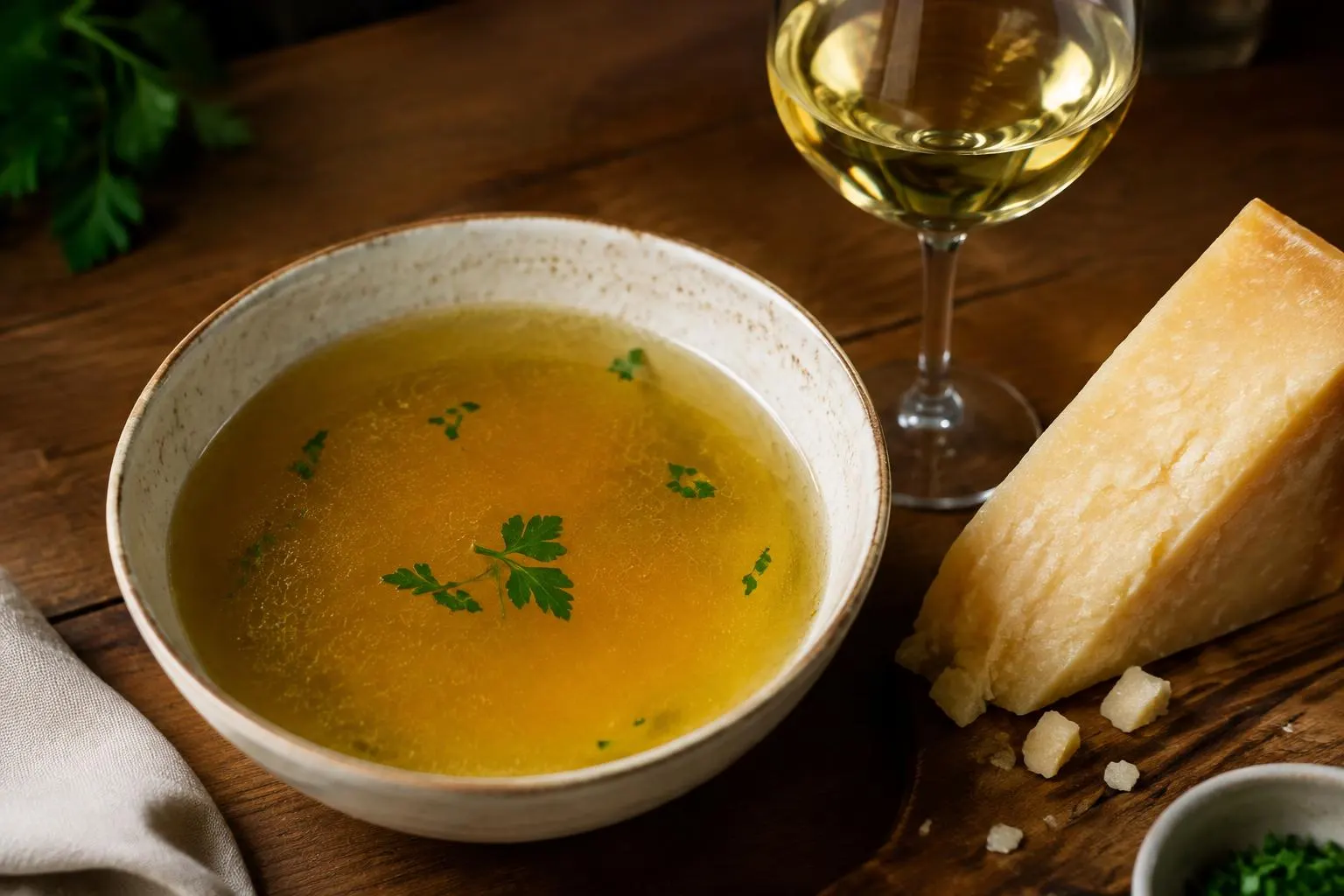
The warmth stays a moment longer
A cup of rich broth looks unassuming. No crisp edges, no colourful garnish, just a warm aroma and perhaps a few shimmering droplets of fat. Yet a spoonful can fill the mouth to a surprising degree. Beside it sits a piece of aged cheese, firm and crumbly. This is food that doesn't need to make a grand entrance to leave a lasting impression.
A structured Chardonnay, dry Chenin Blanc or low-tannin Spätburgunder can complement that depth. But the word kokumi alone cannot tell you which wine will work best. Light vegetable broth, rich meat broth and a very salty hard cheese each make different demands. Only tasting the food itself reveals how much freshness, body and fruit it needs.
Not a sixth basic taste
Kokumi refers to a sense of fullness, richness, continuity and mouthfulness. It is not a sixth basic taste alongside sweet, sour, salty, bitter and umami. Rather, the term describes a sensory quality that can amplify and prolong other impressions in food. Simply translating kokumi as umami is therefore taking a little too much of a shortcut.
Research by Ohsu and colleagues from 2010 links this effect to glutathione and certain gamma-glutamyl peptides that act on the calcium-sensing receptor, or CaSR. This offers a biological explanation, not a magic formula for the kitchen. A long cooking time does not, in itself, prove any particular level of kokumi. Nor can every comforting, creamy sensation readily be attributed to this mechanism.
In broth, for example, gelatin, fat, temperature and concentration can all contribute to mouthfeel. In aged cheese, texture, salt, fat and numerous aromas developed during ageing come together. It makes sense to describe these impressions rather than gather them all under a new favourite word. Kokumi explains some of the sensory possibilities, but it is no substitute for careful tasting.
Wine needs more than volume
Umami is distinctly present in many broths and aged cheeses. It can make wine seem more bitter, astringent and acidic, while fruit and sweetness recede. Salt, in turn, can soften bitterness and the sensation of tannins. This is why the same wine tastes different with a barely salted broth than with a salty piece of cheese. The article on miso, mushrooms and Parmesan explains this interplay in more detail.
A Chardonnay with some texture and restrained oak suits a light yet substantial broth or a nutty cheese. It should have enough acidity to feel fresh after fatty bites. Plenty of new oak is no substitute for substance. Its toasty aromas can simply overwhelm a delicate broth. With distinctly browned ingredients, the wine can afford to be a little bolder aromatically.
Dry Chenin Blanc often brings pronounced acidity and ample body. That is helpful when cheese fat and concentrated broth come together. A carefully handled Spätburgunder, meanwhile, offers red fruit alongside darker broth and hearty additions. Low tannins are often an advantage here. With very intensely flavoured cheese, its fruit should not be too delicate. A look at aged hard cheese offers more pointers.
Interactive wine selector
How do you prepare Long-simmered broth with aged cheese?
The default is a typical preparation. Adjust the settings to how your dish actually tastes, and the suggestions update instantly.
Wine styles to suit your dish
Choice 1
Champagne or grower-produced Sekt brut
Why it works: it is low in tannins and handles umami well and salt makes it softer and rounder.
Choice 2
Grüner Veltliner
Why it works: it is low in tannins and handles umami well and acidity and freshness cut through the fat.
Get to know the Grüner Veltliner grape varietyChoice 3
Oak-aged Chardonnay
Why it works: it is low in tannins and handles umami well and acidity and freshness cut through the fat.
Get to know the Chardonnay grape variety
Best avoided – Sweet red wine, such as Ruby Port. As a rule here, it is much sweeter than the dish and tastes cloying alongside it. Individual wines may vary.
The suggestions are wine styles, not specific bottles. Taste is personal, so feel free to try something that breaks the rules.
Two cups instead of grand theory
For a small experiment at home, divide the same warm broth between two cups. Leave one unchanged and add a little finely grated aged hard cheese to the other. Taste a spoonful of each, followed by the same white wine. Pay attention to fullness, length, salt and the wine's fruit, without automatically attributing the differences to kokumi alone.
This comparison changes several things at once, including salt, fat and umami. That is precisely why it is a kitchen experiment rather than evidence of a receptor process. It still helps answer the practical question of whether the wine suits the actual meal. If the broth is very hot, let it cool a little so that temperature and steam do not obscure all the finer impressions.
A heavily tannic red wine is a risky choice alongside umami-rich broth, even if the cheese brings some salt. It is more likely to work with pieces of meat and pronounced roasted flavours than with a cup of clear broth alone. For an alcohol-free option, unsweetened, gently brewed Rooibos makes a quiet, warm companion. It copies neither wine nor its interplay of acidity. That can be welcome when the broth and cheese already provide enough to talk about.
Brief and honest
- Structured Chardonnay with little oak – Texture complements the fullness, while sufficient acidity refreshes the palate after the cheese's fat. More about Chardonnay
- Dry Chenin Blanc – Body and lively acidity can stand up to concentrated broth and aged cheese. More about Chenin Blanc
- Low-tannin Spätburgunder – Juicy fruit complements darker broth without adding much astringency. More about Spätburgunder
Wine advisor: find the right grape variety in three questions · All grape varieties at a glance
Probably not – Big, tannic young red wine. Umami can accentuate the astringent structure. The pairing is more plausible with pieces of meat, salt and pronounced roasted flavours than with clear broth alone.
Alcohol-free – Unsweetened, gently brewed Rooibos makes a quiet, warm companion. It does not replace a wine's interplay of acidity, but neither does it add the tannic structure of red wine.
How helpful was this article?
No sign-up and no cookies. We only store the stars, the article and a non-traceable identifier that changes daily to prevent repeat ratings. Ratings appear only after editorial review.
Try this at home
Divide the same warm broth between two cups. Add a little finely grated aged hard cheese to one and leave the other unchanged. Taste both with the same white wine and compare fullness, length, salt and fruit. The experiment does not isolate kokumi, because several components change at once.
What this article is based on
- Ohsu et al. (2010), Involvement of the calcium-sensing receptor in human taste perception, Journal of Biological Chemistry
- WSET Level 2 Award in Wines, Spezifikation mit dem Kapitel zu Wein und Speisen
The scenes in this article are illustrative stories, not reporting. The basic rules follow WSET teaching; personal taste may differ.