Wine Travel · October 2026
15.5 Percent and Already Harvested in September: What Is Happening to Barolo?
Our encounters in Barolo show how heat, earlier grape ripening, and powerful Nebbiolo wines are challenging winemakers in Piedmont.
3 min read
By Stefan Tappert · on the road in October 2026
15.5 percent alcohol by volume. That is quite a statement. On our wine journey through Piedmont, in the area around Barolo, we remember having such powerful wines in our glasses. Nebbiolo can do a lot: be fragrant, demanding, age for a long time. But it does not necessarily have to show up with so much alcohol. We wonder how winemakers maintain the balance.
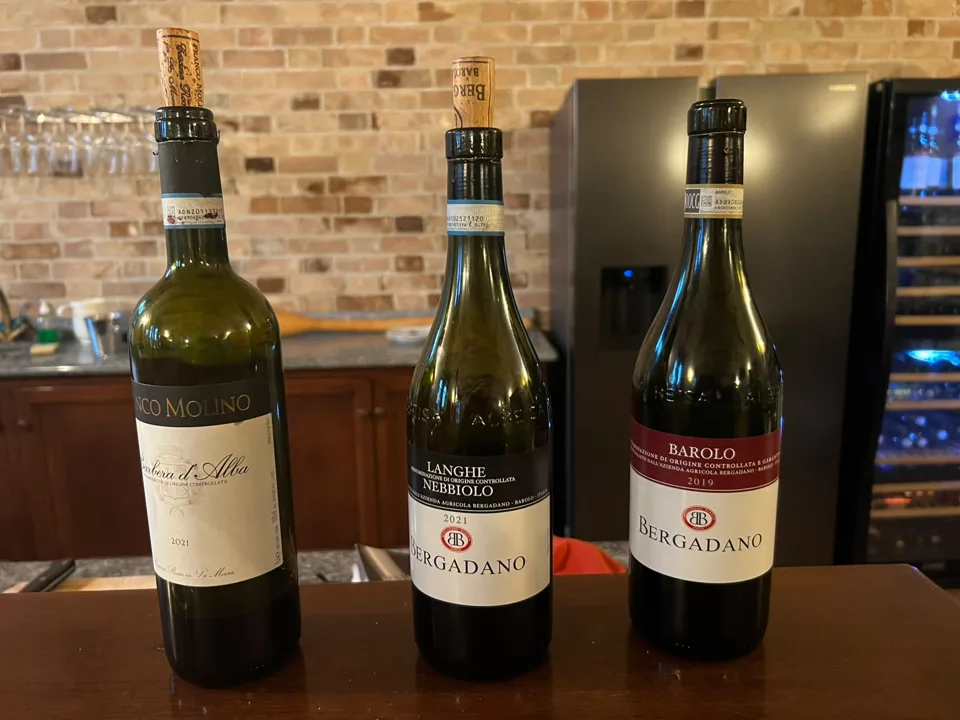
This observation belongs to Barolo and Piedmont. Not to the Lieselehof, not to Kaltern, and not to South Tyrol. We do not link a specific winery or vintage to the 15.5 percent figure as long as the matching label is missing. In fact, the existing photo of our Bergadano Barolo 2019 shows 14.5 percent and is certainly no proof of that.
What We Heard – and What the Harvest Report Says
During conversations on site, we hear that some grapes were already being harvested in early September to prevent them from becoming too ripe. That is our observation from these discussions. From these notes, we do not know for certain which variety, parcel, or year was meant in each statement.
This is explicitly not a claim that all Barolo Nebbiolo harvests take place in early September. The Consorzio's official harvest report for the Langhe 2025 describes the Nebbiolo harvest as starting from the end of September. For early September, it mentions other varieties or harvest phases. The report refers to 2025; our trip took place in October 2026. Different years and varieties cannot be lumped together into one blanket story.
Sugar, Acidity, and Tannins Must Come Together
Warm growing seasons can alter the ripening process and accelerate sugar accumulation. Fermentable sugar can lead to more alcohol in the finished wine. However, this does not result in a simple formula where any higher temperature in any vineyard site automatically produces more sugar and more alcohol.
The challenge lies in the balance: sugar ripeness, acidity, and phenolic ripeness, especially the development of the tannins, must align. Harvesting too early risks unripe tannins. Waiting a long time can, depending on the season, risk high alcohol levels and shifts in acidity. Slope orientation and elevation play a role, but “the higher, the better” would be too simplistic.
Research Directly on Nebbiolo in La Morra
A research paper published in 2024 with the participation of the University of Turin examined Nebbiolo in 2022 and 2023 in three vineyards at different elevations in La Morra. The researchers altered temperature and UV exposure and analyzed, among other things, anthocyanins, flavonols, and other phenolic compounds.
The results show nuanced effects on berries and their constituents. Under elevated temperatures, the sugar content per berry in this experiment was actually negatively affected. This is not a refutation of every observation of earlier ripening, but rather a good reason not to reduce climate to a single number. The study specifically investigates color and phenolic components; making a sweeping statement about all aromas or all Barolo vintages would be more than the abstract warrants.
Power Isn’t Everything
We are not climate scientists. We met people, had conversations, and tasted unusually powerful wines. These experiences make us curious about what adaptation in the vineyard and cellar looks like in practice. They do not replace long-term measurements.
Barolo remains a wine of origin from Piedmont, made exclusively from Nebbiolo. Origin, character, and maturity are part of it. Perhaps the balance between power and elegance will become even more valuable in the future. For us, at any rate, one thing is clear: the most exciting question at the table is not how much alcohol a wine can display, but whether everything comes together.
Sources and Context
Personal travel memories of Stefan Tappert, supplemented by the sources listed below. Conversations, tasting impressions, and availability at the time do not represent current offers.
https://www.langhevini.it/wp-content/uploads/2026/01/COMUNICATO-VENDEMMIA-2025-EN.pdf
https://pubmed.ncbi.nlm.nih.gov/39599366/
https://www.enogea360.it/en/barolo/barolo-the-appellation-in-a-nustshell/
Wine Tour Through France and Italy
Von Barbaresco nach Bardolino: Ein halber Liter Hauswein, eine Pizza und die Flucht vor dem Gardasee
Revena Farm: Ein roter Traktor, ein Rosato und ganz viel italienische Gastfreundschaft
Enantio: Dieser Rotwein sagt nicht „Hallo“, der stellt sich vor!
Lieselehof in Kaltern: Ein Weinberg, der nach Erdbeeren schmeckt, und ein Sekt, der uns umhaut
15,5 Prozent und schon im September gelesen: Was passiert mit dem Barolo?
Die Weinpost